Sourcing guide
Stainless Steel vs MDF vs Plywood Bathroom Vanities
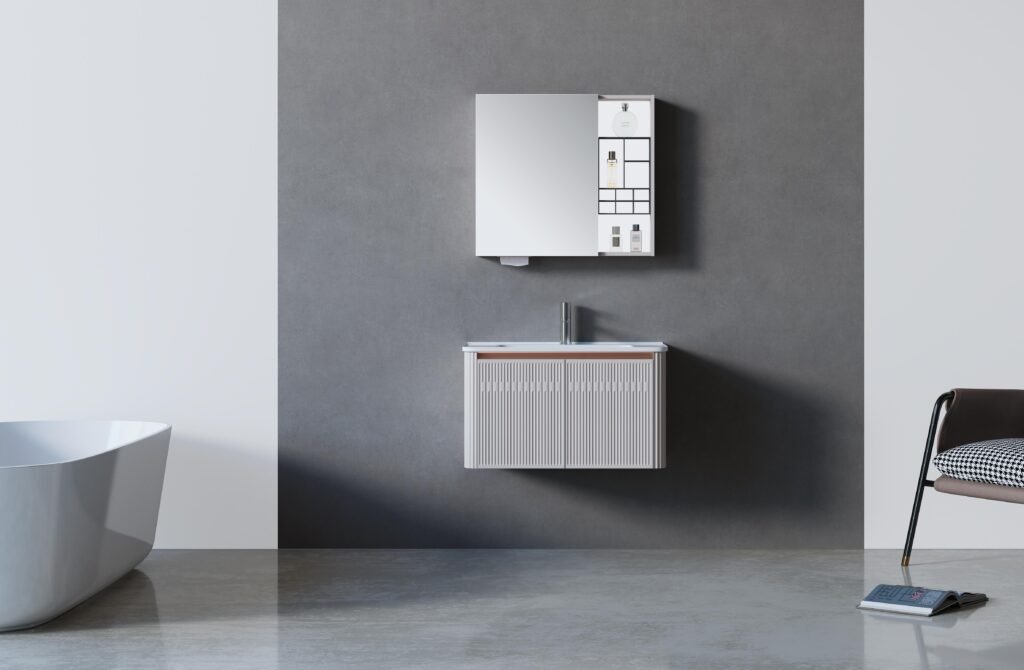
The cabinet material is the single biggest factor in how long a bathroom vanity lasts. Bathrooms combine steam, splashes and cleaning chemicals, and a cabinet that looks perfect in the showroom can swell, peel or rust within a few years if the material is wrong for the room. For distributors, hotels and developers this shows up as returns, complaints and replacement costs.
This guide compares the three materials most often used in imported vanities – stainless steel, MDF and plywood – and explains what to specify for each.
The short comparison
| Stainless steel | MDF | Plywood | |
|---|---|---|---|
| Response to moisture | Does not absorb water or swell | Swells if the edge or surface sealing is damaged | More stable than MDF; can still delaminate or swell if left wet |
| Typical failure | Surface marks or corrosion on low-grade steel | Swollen edges around the basin and doors | Peeling veneer or edge damage |
| Finish options | Brushed, powder coated colours, wood-grain transfer | Lacquer, melamine, PVC/thermofoil | Veneer, lacquer, laminate |
| Weight and freight | Light for its strength | Heavy | Medium |
| Emissions | No resin-based board | Depends on board grade (formaldehyde) | Depends on glue grade (formaldehyde) |
| Price level | Higher | Lowest | Middle to higher |
Why MDF vanities fail in bathrooms
MDF is a dense board made from wood fibres and resin. It machines cleanly and takes paint and lacquer well, which is why it dominates low-cost vanities. Its weakness is water: once moisture reaches the core – through a chipped edge, a drilled hole, the cut-out under the basin or a gap in the sealing – the fibres absorb it and the board swells. Swelling is permanent and usually starts exactly where water collects, around the basin and at the bottom of the doors.
Moisture-resistant MDF grades and careful edge sealing reduce the risk but do not remove it, and the sealing quality is hard to check in a sample.
Plywood: better, but still wood
Plywood is built from thin layers of wood glued with alternating grain. It holds screws well, is more dimensionally stable than MDF and tolerates occasional moisture better, especially when made with water-resistant glue. It is still an organic material, though: long exposure to water can cause delamination, and the face veneer or laminate can lift at the edges.
Stainless steel vanities
A stainless steel cabinet does not absorb water, so there is nothing to swell or delaminate. That makes it well suited to bathrooms with poor ventilation, hotel rooms that are cleaned daily, and humid climates. Stainless steel is also easy to clean and does not rely on resin-bonded boards.
The quality of a stainless steel vanity depends on three things you should specify:
- Steel grade. Grade 304 (an austenitic chromium-nickel steel) has good corrosion resistance for bathroom use. Lower-cost grades with less nickel and chromium, such as 201, are cheaper but more prone to surface rust in humid or chlorinated environments. Ask which grade is used for the carcass, doors and internal parts – they are not always the same.
- Sheet thickness. Thicker sheet gives stiffer doors and panels and a more solid feel. Ask for the thickness of each main part rather than one figure for the whole cabinet.
- Surface finish. Brushed steel, powder coated colours and wood-grain transfer finishes are all common. For coated finishes, ask how the surface is pre-treated and agree a colour sample.
What else to specify for any vanity
- Countertop and basin: ceramic, solid surface, quartz or integrated basin; tap-hole position and overflow.
- Hardware: hinges and drawer runners (soft-close or standard), handle type, and the material of screws and fixings.
- Mirror cabinet and lighting: mirror type, LED lighting, demister pads, switches and the plug or wiring standard of your market.
- Installation: wall-hung or floor-standing, wall bracket design and the space needed for the trap and supply pipes.
- Packaging: knocked-down or assembled, carton strength, corner protection and carton dimensions for container loading.
For vanities with lighting or electrical parts, electrical safety rules apply in most markets in addition to furniture requirements. Confirm the electrical configuration and the documentation available for your market before you order.
Which material should you choose?
MDF still makes sense for price-driven ranges and well-ventilated bathrooms. Plywood is a reasonable upgrade where wood finishes are expected. Stainless steel is the strongest choice where durability matters more than the lowest purchase price – hotels, rental apartments, humid climates and ranges sold with a longer warranty – because it removes the most common cause of vanity failure altogether.
DACHENG makes stainless steel bathroom vanities and mirror cabinets. You can compare the current stainless steel vanity models and the DACHENG Stainless Steel Vanities range, then send your target sizes and quantities for a quotation.